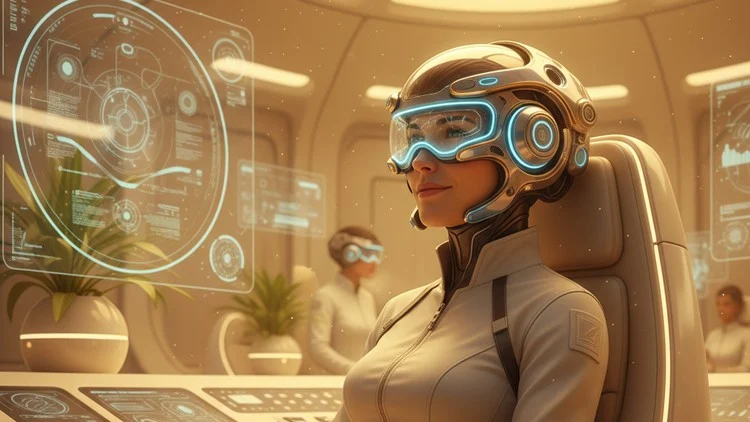
Unlock secrets of brain-machine communication and become an expert in BCIs, neuroengineering, and human-AI integration.
Note: Course Free for limited time and limited users(500 limit) so Enroll ASAP. If not free it means you are late. Scroll Down and click Enroll Now button to get enrolled
Scroll Down and click Enroll Now Button to get enrolled into the Free Course
Apply Coupon Code: FEBFREE03
What you’ll learn
- Understand how the human brain generates neural signals and how BCIs interpret them.
- Record, filter, and process EEG data to extract meaningful neural features.
- Build real BCI pipelines using signal processing, machine learning, and real-time tools.
- Develop hands-on applications like neurofeedback, device control, and mental-state decoding.
- Use industry frameworks such as OpenBCI, BrainFlow, MNE, and LSL for BCI development.
- Evaluate neuroethical, privacy, and security risks and design responsible neurotech systems.
Explore related topics
This course includes:
- 7.5 hours on-demand video
- 13 articles
- Access on mobile and TV
- Full lifetime access
- Closed captions
- Certificate of completion
Course content
10 sections • 59 lectures • 8h 16m total length
- Certificate of Completion
- What Are BCIs and Why They Matter
- Historical Evolution of Neurotechnology
- The Brain-Machine Paradigm: Human-AI Integration
- Applications Across Healthcare, Defense, Gaming, and Accessibility
- Overview of BCI Categories (Invasive, Non-Invasive, Hybrid)
- Lab 1 – Build Your First Brain-Signal Recorder (EEG Streaming Test)
- Fundamentals of Neuroanatomy and Neurons
- Action Potentials and Synaptic Transmission
- Neural Oscillations and Brain Rhythms
- Brain Regions for Motor Control, Vision, and Cognition
- Measuring Brain Activity (EEG, fMRI, MEG, ECoG)
- Lab 2 – Measure Your Alpha, Beta, and Theta Brain Waves
- EEG, ECoG, and Implantable Electrodes
- Sensors, Amplifiers, and Noise Reduction
- Sampling, Filtering, and Signal Conditioning
- Wearable BCIs and Consumer Neurotech Devices
- Emerging Interfaces (Optical, fNIRS, Ultrasound, Nano-BCIs)
- Lab 3 – Build an EEG Filtering & Noise-Reduction Pipeline
- Time, Frequency, and Time-Frequency Analysis
- Feature Extraction (P300, SSVEP, ERD/ERS)
- Artifact Removal (Eye Blinks, Muscle Noise)
- Dimensionality Reduction (PCA, ICA)
- Real-Time Processing Pipelines
- Lab 4 – Extract P300 and SSVEP Features from Simple Visual Stimuli
- From Features to Intent: Pattern Recognition in BCIs
- Supervised and Unsupervised Learning for Neural Data
- Deep Learning Architectures for Signal Decoding
- Transfer Learning and Adaptive BCIs
- Evaluation Metrics and Cross-Validation
- Lab 5 – Train a Machine-Learning Classifier for Brain Signals
- Closed-Loop BCIs and Feedback Mechanisms
- Neurostimulation (tDCS, TMS, DBS)
- Haptic, Auditory, and Visual Feedback in BCIs
- Adaptive Control and Reinforcement Learning
- Cognitive State Monitoring
- Lab 6 – Build a Real-Time Neurofeedback System (Closed-Loop BCI)
- BCIs in Medicine: Prosthetics, Stroke Rehab, Epilepsy
- Communication BCIs for Locked-In Patients
- BCIs in Gaming, AR/VR, and Human Enhancement
- Brain-Controlled Robotics and Drones
- BCIs in Mental Health and Cognitive Training
- Lab 7 – Control a Device Using Your Brain (LED, Keyboard, or Cursor Control)
- EEG/BCI Software: OpenBCI, BrainFlow, EEGLAB, MNE-Python
- BCI APIs and SDKs (Emotiv, NeuroSky, Neurable)
- Signal Simulation and Visualization
- Real-Time Processing with Python and MATLAB
- Building Custom Pipelines with Open Source Tools
- Lab 8 – Hands-On With BCI Frameworks & SDKs
- Neuroethics: Privacy, Consent, and Cognitive Liberty
- NeuroRights and Brain Data Protection
- Dual-Use Dilemmas: Enhancement vs Manipulation
- Societal and Legal Implications of Thought Interfaces
- Policy and Governance in the Neurotech Era
- Lab 9 – Neuroethics, Security, and Cognitive Privacy
- Build a Simple EEG-Based Control Interface (e.g., blinking LED or cursor)
- Classify Mental States Using Real EEG Data
- Design a Neurofeedback System Prototype
- Draft a Whitepaper on a Future Neuro-AI Innovation
- No prior neuroscience or neurotechnology experience required.
- Basic familiarity with computers and installing software is helpful.
- Optional but useful: beginner-level Python programming knowledge.
- Access to a Windows, macOS, or Linux computer for running tools.
- An EEG headset (OpenBCI, Muse, Emotiv, etc.) is recommended but not required—simulated data is provided.
- Curiosity about the brain, AI, and emerging technologies is the most important requirement.
Description
Mastering Brain-Computer Interfaces & Neurotechnology is the ultimate end-to-end program designed to take you from complete beginner to advanced practitioner in the emerging world of brain-machine communication. This course unpacks the science, engineering, and innovation behind how the human brain interacts with computers, exploring everything from neuroscience fundamentals to AI-driven neural decoding, signal processing, and real-world BCI applications.
You’ll begin with a deep dive into neuroanatomy and brain function, learning how neurons fire, transmit information, and form the biological basis of thought and movement. You’ll then explore the hardware and sensors that make BCIs possible — from EEG headsets to implanted electrodes, neural amplifiers, and signal-conditioning circuits. Whether you’re a student of neuroscience, an engineer, or simply a tech enthusiast, you’ll gain an understanding of how brain signals are captured, filtered, and analyzed in both clinical and research environments.
Next, you’ll learn the core of any modern BCI system — signal processing and machine learning. Using real data, you’ll practice filtering noise, extracting features, and building models that translate neural patterns into actionable outputs. With a focus on AI-based neural decoding, you’ll discover how deep learning, transfer learning, and reinforcement learning are reshaping the way we interpret brain activity and enable seamless human-computer interaction.
The course then expands into closed-loop neurostimulation and feedback systems, showing how BCIs not only read from the brain but also write back — enhancing rehabilitation, prosthetic control, and even cognitive performance. Through case studies and practical labs, you’ll explore BCIs for medical restoration, mental health monitoring, VR/AR gaming, and neuroprosthetic design.
You’ll gain hands-on exposure to leading neurotech tools and frameworks like OpenBCI, BrainFlow, MNE-Python, and EEGLAB, empowering you to build your own neural interfaces and experiment with real EEG signals. From designing your first mind-controlled interface to simulating thought-based commands, every lesson bridges theory with application.
But technology alone isn’t enough — so you’ll also explore neuroethics, neural data privacy, and the emerging concept of cognitive liberty. You’ll learn about neurorights, data protection frameworks, and the moral boundaries of reading and influencing human thought.
Finally, you’ll complete a capstone project that integrates everything learned: either by designing a working BCI prototype, decoding real EEG data, or proposing a future neuro-AI innovation.
By the end, you’ll emerge with a strong foundation in neuroengineering, AI for brain data, and human-machine symbiosis — ready to innovate in healthcare, gaming, research, or cognitive technology startups.
If you’ve ever imagined controlling technology with your mind or shaping the next generation of neuro-AI systems, this course is your complete roadmap.
Disclaimer: This course contains the use of artificial intelligence(AI).
Who this course is for:
- Beginners curious about how brains and computers interact and want a structured introduction.
- Students and professionals interested in neuroscience, AI, biomedical engineering, or cognitive science.
- Developers, data scientists, and ML engineers wanting to apply their skills to neurotechnology.
- Innovators and entrepreneurs exploring brain-tech, wearable tech, or human-AI integration ideas.
- Researchers and practitioners seeking hands-on BCI experience with real tools and datasets.
- Anyone looking to build neurofeedback systems, mind-controlled apps, or next-generation neurotech products.
Note: The course is free for a limited time and limited to 500 users. Enroll as soon as possible. If it is no longer free, it means you are late, and it has already exceeded its limits.
🚨How to Enroll into free Udemy courses
👉 https://youtu.be/bN6IfeIW-6E?feature=shared
🎫 After adding the course into Cart at Checkout page, Apply Coupon Code➛. FEBFREE03 Note:- After applying coupon, if it says ”This coupon has exceeded its maximum possible redemptions…”, then it means you’re Late, and first 500 coupons already redeemed.


